
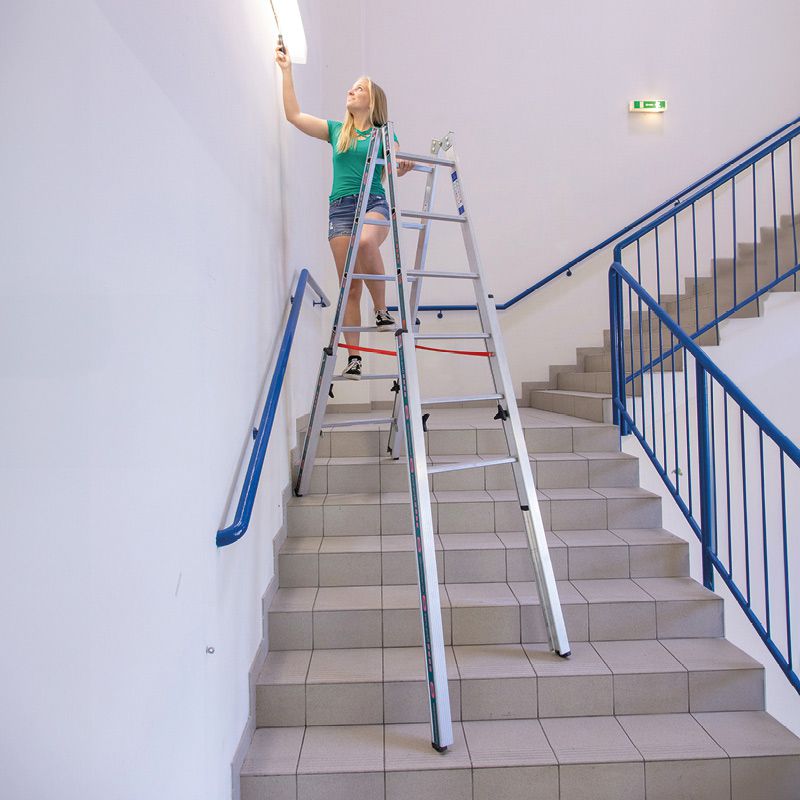
Treppenleiter – Einsatzbereiche, Sicherheit, Materialien und Kaufberatung für das ideale Steigsystem
Introduction
The stepladder is one of the most versatile climbing aids in private and commercial settings.It is used wherever conventional ladders reach their limits – especially on stairs, platforms and uneven surfaces. While normal ladders only stand securely on level ground, the step ladder also allows stable and risk-free work on inclines and steps.This comprehensive article examines all the important aspects of stepladders: their function, areas of application, materials, safety standards, purchasing criteria, and care instructions. This will give you a deep understanding of this practical tool and enable you to make an informed purchase decision.
What is a stepladder?
A step ladder is a special type of ladder characterized by a height-adjustable design.Its stiles or legs can be adjusted so that the ladder stands securely even on steps of unequal height.Unlike traditional extension or step ladders, the step ladder offers flexible adjustment options to compensate for different heights.This allows the user to work in stairwells, on sloping roofs or on facades at different levels.
Why a stepladder is indispensable
An ordinary ladder cannot be used safely on sloping or uneven surfaces. Even slight differences in height can lead to dangerous instability.The step ladder, on the other hand, was specifically designed to level the standing surface and safely compensate for differences in height.
Your advantages:
-
High stability even on stairs
-
Flexibly adjustable height
-
Ideal for interior renovations
-
Versatile applications
-
Space-saving and easily transportable
-
Available in numerous variations to suit different needs.
Anyone who regularly works in stairwells or on platforms not only saves time with a stepladder, but also significantly increases their own safety.
Areas of use of a stepladder
The stepladder is used in many areas of life – both in the home and in the professional sector.
Stairwell work
The most frequent use is in the traditional stairwell. Typical activities:
-
Lamp mounting
-
Painting and wallpapering
-
Cleaning walls and stair railings
-
Cable routing
-
Installation work on ceilings
Crafts & Construction
In the construction and trade sectors, stepladders are part of the daily equipment:
-
Electrical installations
-
Drywall
-
Renovation work
-
Installation of railings and railing infills
-
Work on uneven floors in the shell construction
Commerce, Industry & Services
Even in professional industries, the stepladder is an indispensable tool:
-
Building cleaning
-
Maintenance company
-
Exhibition stand construction
-
Facility Management
-
Warehousing and logistics
Private household
In the home, stepladders are used for:
-
Spring or winter cleaning
-
Window cleaning
-
Lampenwechsel
-
Wall design
-
Working in the basement or attic
A step ladder is therefore a multifunctional climbing system that offers added value in almost any environment.
Types of step ladders
Step ladders are available in various designs. Each design has its specific advantage.
Stepladder with height adjustment
This classic design features independently adjustable legs to adjust the standing height.
Combination ladder (multi-functional ladder)
Multi-section ladders that can be adjusted for working on stairs – particularly flexible.
Telescope leader
The telescopic ladder can be extended in stages, is ultra-compact and particularly easy to transport.
Ladder with leveling system
This version leans against walls or railings and has a height-adjustable leg for stabilization.
Platform stair ladder
Professional design with a large standing platform for extended periods of work on a safe surface.
Materials and their properties
Step ladders are made from different materials – each offers its own advantages and disadvantages.
Aluminium
Aluminium is the most popular material:
-
Lightweight and robust
-
Corrosion resistant
-
Weatherproof
-
High load capacity
-
Ideal for professional and private use
Stahl
Primarily used in the commercial sector:
-
Extremely durable
-
Heavier than aluminum
-
Very stable under intensive, continuous use.
Wood
Traditional version, rather rare today:
-
Natural materials
-
Electrically non-conductive
-
Less suitable for damp areas
-
Slightly heavier and requires more care
Fiberglas / GFK
Especially popular with electricians:
-
Non-conductive
-
Very safe
-
Robust and durable
-
Slightly more expensive
Important safety features of a stepladder
Safety is the fundamental criterion when handling ladders.
Non-slip feet and ladder rungs
Non-slip rubber feet ensure a firm footing. Grooved steps provide additional grip.
Stable spreader lock
A high-quality connection between the conductor sides prevents uncontrolled folding.
Height adjustment with locking mechanism
High-quality models have secure locking or screw mechanisms that prevent unintentional adjustment.
Standards & Certificates
Important standards:
-
EN 131 – European standard for ladders
-
GS mark – tested safety
-
DIN standards – specific German quality requirements
A stepladder without certification should generally not be used.
How to use a stepladder correctly
Proper application significantly increases safety.
Set up
-
Always place all feet in a clean and non-slip position.
-
Lock the height adjustment correctly
-
Never improvise (e.g., by putting books underneath)
Working on a ladder
-
Never lean too far to the side
-
Always keep both feet fully on the steps.
-
Use a tool bag instead of carrying it by hand.
After use
-
Clean ladders
-
Check mechanisms
-
Let dry
-
Store in a dry place
Buying advice – what you should pay attention to
A good stepladder is a long-term investment.Therefore, you should consider the following criteria:
1. Material
Depending on the intended use, you should choose aluminum, steel, or fiberglass.
2. Height adjustment
The more adjustment levels, the more flexible and safer.
3. Load capacity
A load-bearing capacity of at least 150 kg is required.
4. Intended Use
-
Private
-
Business
-
Construction site
-
Electricity
-
Building or window cleaning
5. Weight and transport
Lightweight models are suitable for everyday use, heavier ones for continuous professional use.
6. Stand platform
Platform ladders are recommended for longer tasks.
7. Manufacturer quality
Well-known brands benefit from experience, testing, and high safety standards.
Care and maintenance of a stepladder
Regular maintenance extends the service life.
cleaning
-
Remove dirt and dust
-
Clean aluminum with a mild cleaner
control
-
Lubricating joints
-
Tighten screws
-
Check rubber feet
storage
-
Store in a dry place
-
Do not leave outdoors
-
Protect from heat or frost
Common mistakes when using a stepladder
The most common mistakes include:
-
Working on damaged ladders
-
Unlocked adjustment mechanisms
-
Improper positioning
-
Working at excessive heights
-
overload
-
Sideways leaning or imbalance
Working consciously prevents accidents.
Conclusion
The stepladder is an indispensable tool for anyone who wants to work safely on stairs or uneven surfaces.Whether in the home, in the trades or in industry – the stepladder offers flexibility, safety and efficiency.High-quality materials, reliable safety mechanisms, and well-designed construction ensure safe work at various heights.
Anyone looking to buy a stepladder should pay attention to quality, safety, load-bearing capacity, and stability. With proper care and careful use, the stepladder will remain a reliable companion for many years.

Related Posts

Fensterreiniger – Der umfassende Ratgeber zu Arten, Anwendung, Tipps und moderner Reinigungstechnologie

Charlotte Tilbury Setting Spray – Wirkung, Anwendung, Vorteile und umfassender Beauty-Guide für langanhaltendes Make-up